
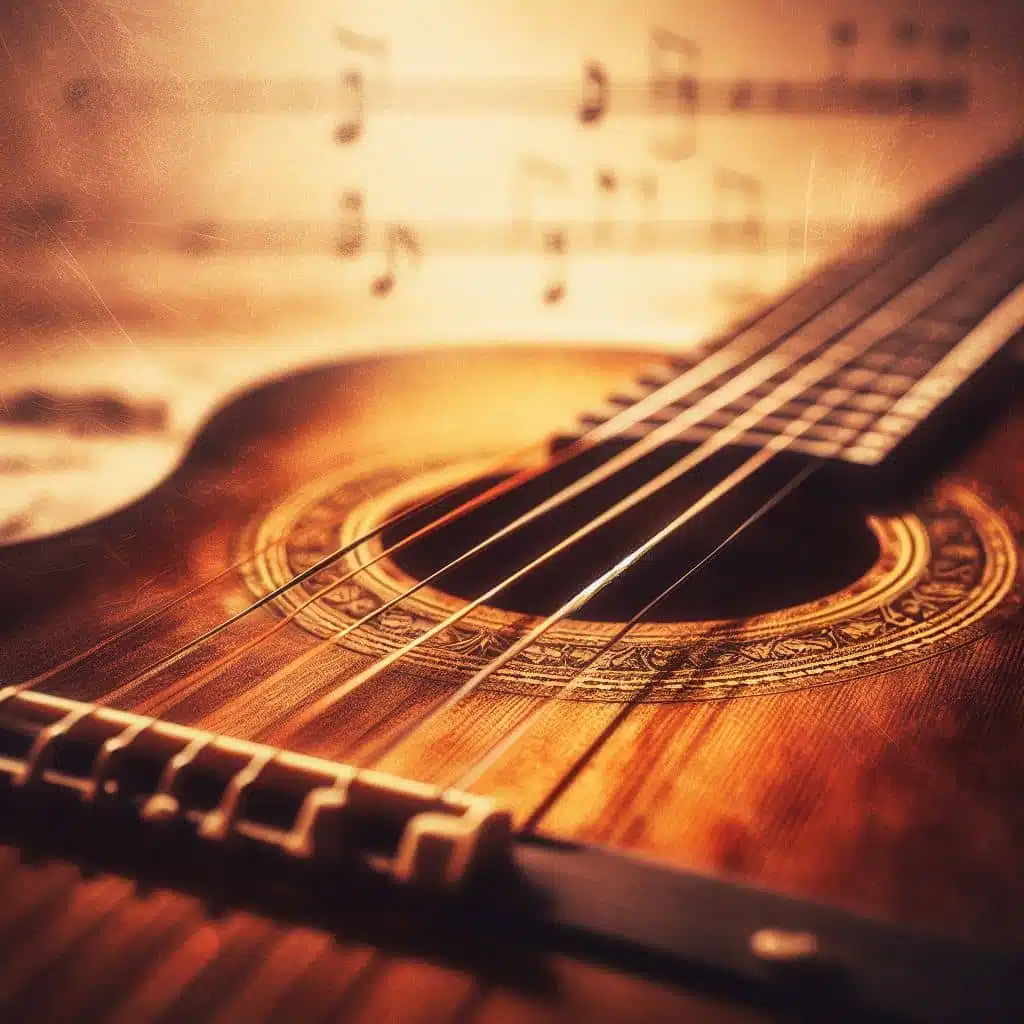
The classical guitar, also known as the Spanish guitar, is a plucked string instrument with a long and rich history. From the Renaissance to the present day, it has remained one of the most popular and versatile instruments in the world. It is used for solo and ensemble music, as well as for accompanying songs and dances. The guitar plays a prominent role in the musical traditions of South America, where various composers and performers have adapted and transformed it to create a distinctive repertoire.
The Origins and Development of the Classical Guitar
The classical guitar descends from several ancient stringed instruments, such as the Greek kithara, Persian barbat, Arabic oud, and European lute. However, its direct ancestor is the vihuela. Popular in Spain and Italy during the 15th and 16th centuries, the vihuela had a similar shape and tuning to the modern guitar. It featured a flat back and vaulted top, and composers like Luis de Milán and Alonso Mudarra wrote sophisticated music for it.
Over time, the vihuela gave way to the baroque guitar, a five-course instrument that emerged in the late 16th century. This smaller guitar had a more curved body and gut strings. Musicians primarily used it to accompany songs and dances. Its expressive style relied on strumming and plucking techniques, known as rasgueado and punteado. Composers like Gaspar Sanz and Francesco Corbetta contributed to its colorful repertoire.
The baroque guitar eventually evolved into the early romantic guitar, which appeared in the late 18th century. This six-course instrument had a larger, more resonant body and used metal-wound strings. It gained popularity for solo and chamber music, employing refined fingerstyle and arpeggio techniques. Fernando Sor and Mauro Giuliani were key figures in shaping its elegant repertoire.
Antonio de Torres and the Modern Classical Guitar
During the 19th century, Spanish luthier Antonio de Torres revolutionized the classical guitar’s design. He increased its body depth, soundboard area, and string length. He also introduced the fan-bracing system, significantly improving sound quality and projection. Torres experimented with various woods, such as spruce and rosewood, and decorated his guitars with intricate rosettes and inlays.
Torres’ instruments influenced legendary guitarists like Francisco Tárrega and Julián Arcas. His innovations also inspired future luthiers, including Hermann Hauser and José Ramirez. These craftsmen continued refining the guitar’s design throughout the 20th century. Notable examples include the 1937 Hauser I played by Andrés Segovia and the 1969 Ramirez II used by Narciso Yepes.

The Classical Guitar in South American Music
The Spanish introduced the classical guitar to South America in the 16th century. It quickly became widespread across the region. Musicians adapted the instrument for genres such as criollo, zamba, cueca, choro, and bossa nova. They also blended it with indigenous and African traditions, incorporating instruments like the charango and cajón.
In the 20th century, the classical guitar became a powerful tool for artistic expression and cultural identity. Composers from across South America used the guitar to develop new, innovative music, merging classical technique with folkloric roots. Below are three iconic figures who shaped this evolution:
- Heitor Villa-Lobos (Brazil, 1887–1959): Brazil’s most influential composer, Villa-Lobos wrote major guitar works like the Preludes and Etudes. He combined European classical structure with Brazilian folk rhythms, creating vibrant, melodic music.
- Agustín Barrios (Paraguay, 1885–1944): Barrios composed more than 300 pieces for classical guitar. His music reflects both technical brilliance and emotional depth, inspired by Paraguayan polkas and other Latin styles.
- Astor Piazzolla (Argentina, 1921–1992): Famous for revolutionizing tango, Piazzolla brought classical guitar into his compositions. His Histoire du Tango and Tango Suite blend jazz, tango, and modern classical music.
Conclusion
The classical guitar is more than a musical instrument. It represents centuries of cultural exchange, craftsmanship, and creativity. From the vihuela and baroque guitar to the modern form perfected by Torres, it has evolved to suit changing musical tastes. In South America, it continues to thrive—thanks to the work of composers like Villa-Lobos, Barrios, and Piazzolla—bridging classical tradition with rich regional identities.
